

Benefits of the natural alternative to retinol
Vitamin A and its derivatives (retinol and retinoids) are used in many skincare products as conditioning agents.
- Retinol is a form of vitamin A, also known as a retinoid.
- Retinol plays a vital role in cell renewal and promoting healthy skin.
How does retinol work?
When applied to the skin, enzymes in the body convert it into an active form called retinoic acid, which:
- stimulates collagen production
- reduces the appearance of wrinkles and evens out skin texture
- helps fade age spots and acne scars
- helps prevent scarring
Vitamin A and its derivatives (retinol and retinoids) are used in many skincare products as conditioning agents.
Retinol plays a vital role in cell renewal and promoting healthy skin.
Since vitamin A occurs naturally in fish, eggs, dairy products and other foods, people are exposed to it not only through cosmetics but also through other sources, mainly food and dietary supplements.
However, retinoic acid is broken down in the skin by an enzyme, meaning that larger amounts of retinol need to be added in order to maintain high levels of retinoic acid.
What are the adverse effects of topical retinol?
This can cause skin irritation and may also lead to increased absorption into the bones.
Since October 2022, the Scientific Committee on Consumer Safety (SCCS) has confirmed that consumers’ overall exposure to vitamin A may exceed the upper limit established by the European Food Safety Authority (EFSA), although the contribution from cosmetics is lower than that from other sources.
It has been found that it can be very easy to exceed the recommended amount of vitamin A consumed orally.
With a normal diet, it is easy to exceed the average limit.
High levels of vitamin A intake have been found to potentially reduce bone density and contribute to osteoporosis, particularly in postmenopausal women, who represent a key target audience for anti-aging products containing retinol.
The SCCS identified maximum safe limits for the use of vitamin A (retinol and its derivatives) in cosmetic products. As a result, the European Commission incorporated these limits into the new draft regulation.
Restrictions on retinol-based products
The restrictions apply to the following forms of vitamin A: retinol, retinyl acetate and retinyl palmitate.
According to the draft regulation, these substances will be permitted for use in concentrations of up to 0.05% in body lotions and up to 0.3% in other cosmetic products.
The labeling of these products will also have to include the statement: “Contains Vitamin A-related compounds, which contribute to your daily intake of Vitamin A.”
Fortunately, there are plants in nature that offer a viable and highly effective alternative for stimulating the formation of retinoic acid in the skin.
Studies conducted on the aromatic resin of the Pistacia lentiscus tree, native to Greece, and developed as an ingredient under the name NovoRetin have shown that it provides intensive stimulation of retinoic acid in the skin naturally, without causing irritation.
More specifically, NovoRetin is able to inhibit the activity of the enzyme that breaks down retinoic acid in the skin.
Clinical tests have demonstrated the effectiveness of NovoRetin:
- Increased skin elasticity and density by 14–20% after 28 days of use.
- Instant lifting potential and a 14% reduction in wrinkle length after just one application.
- 40% reduction in acne lesions and comedones.
- Reduced pore size.
- More even skin texture.
- Reduced sebum production and intense hydration.
HERBAGEN Serum for Impure and Congested Skin – enlarged pores, acne, excess sebum, wrinkles and dark spots contains highly effective active ingredients of 100% natural origin.
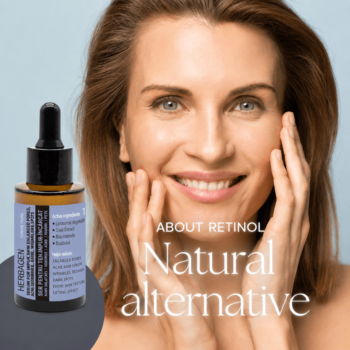
30 ml bottle with pump:
- NovoRetin – naturally stimulates the formation of retinoic acid in the skin
- Snail extract (filtrate) – brightening and anti-wrinkle effect
- Niacinamide – anti-inflammatory, moisturizing and anti-acne properties
- Bisabolol – anti-inflammatory properties
Applied daily, morning and evening, to clean skin:
- Reduces skin imperfections: clogged and enlarged pores, excess sebum, comedones, acne, wrinkles, redness and dark spots
- Evens out skin texture
- Provides a lifting and brightening effect
It can also be used as a base under makeup or sunscreen.
Free from parabens, fragrance, artificial colorants and palm oil.